
ANSI Z87.1 Sunglasses for Outdoor Work:
The One Pair You'd Actually Wear
Most sunglasses are not built for the jobsite. They are built for brunch. That distinction matters when you are on a roof in August, running equipment at a construction site, or working a 10-hour outdoor shift with the sun at a low angle.
Regular sunglasses block some light. They do not protect you from a fragment, a tool kick, or a flying piece of material. They also tend to fail in heat, slip off during physical work, and fog up at the wrong moment.
There is a standard that separates protective eyewear from decorative eyewear. It is called ANSI Z87.1. If your sunglasses do not carry that rating, they are not certified for impact protection — regardless of how thick the lens looks or how much you paid for them.
What ANSI Z87.1-2020 Actually Requires
American National Standard for Occupational and Educational Eye and Face Protection. Administered by the American National Standards Institute. Sets the minimum performance requirements for eyewear used in occupational settings. OSHA references this standard as the requirement for workplace eye protection.
To earn Z87.1 certification, eyewear must pass a series of tests — not just one. These are not marketing claims. They are pass/fail laboratory requirements.
-
01High-Velocity Impact
A steel ball is fired at the lens at speed. The lens must not crack, shatter, or dislodge from the frame. This simulates flying debris, tool kick, or fragment impact in a work environment.
-
02High-Mass Impact
A pointed projectile is dropped from height onto the lens. Same requirement — the lens must not crack, shatter, or dislodge. This covers falling objects and overhead impact scenarios.
-
03Optical Quality Standards
Certified lenses must meet tolerances for distortion and prismatic deviation. Your vision through a Z87-rated lens must be optically accurate — not warped at the edges or distorting your depth perception.
If a pair of sunglasses passes these tests and carries the Z87.1 mark, it has been verified to handle impacts that regular consumer sunglasses have not been designed to withstand. If it does not carry the mark, it has not been tested — regardless of how it is marketed.
For the full breakdown of how the Flatiron is built to this standard, see the DSRT testing and standards page.
Why Lens Material Determines Whether a Sunglass Can Get Certified
Not every lens material can meet Z87.1 requirements. The certification demands very high shatter resistance — higher than most lifestyle lens materials are capable of.
Polycarbonate is the standard lens material for Z87-rated eyewear. It has a ballistic shatter rating above 2.2mm, which is why it is used in safety glasses, shooting glasses, and military-spec eyewear. Compared to nylon or other optical plastics, polycarbonate absorbs more impact energy before failing. It is also light, which matters when you are wearing eyewear for a full shift.
The tradeoff is optical clarity. Polycarbonate has an Abbe number of 30, which means it produces more chromatic aberration at the edges of the lens than higher-clarity materials like nylon (Abbe 52). For a construction worker or tradesman, that tradeoff is accepted — protection comes first.
Any pair of sunglasses claiming Z87.1 certification should be using polycarbonate or a comparable impact-rated material. If the lens is nylon or standard plastic and the brand is claiming Z87 compliance, verify it carefully. For more on polarization, VLT, and lens construction, see the DSRT lens technology page.
What Else Matters for a Jobsite Sunglass
Certification covers impact. It does not cover the other ways sunglasses fail in work environments.
On a jobsite, you are sweating. If the frame does not have rubberized contact points at the nose and temples, the glasses will slide throughout the day. Look for integrated rubberized nose pads and temple tips — not smooth plastic that relies on fit alone.
A flat lens leaves your peripheral vision exposed to wind, debris, and side-angle sunlight. A wraparound frame provides full coverage. For outdoor work in open environments — construction, roofing, utility — wraparound protection reduces both eye fatigue and physical exposure.
Standard consumer hinges loosen over time, especially with repeated on/off cycles throughout a workday. A reinforced screw-backed hinge holds tension longer and resists failure from repeated flexing — something friction hinges cannot do.
On a jobsite, lenses get oily. Sunscreen, sweat, dust, and exhaust all hit the lens surface. Hydrophobic and oleophobic coatings repel water and oil, keeping visibility clear without constant wiping and maintenance through the day.
Any sunglass worth wearing outdoors should block UV radiation up to 400 nanometers — both UVA and UVB. Non-negotiable for extended outdoor exposure. Long-term UV exposure without protection is a direct cause of cataracts and other irreversible eye damage.
Polarized lenses cut reflected glare off flat surfaces — pavement, concrete, metal, standing water, vehicle glass. For outdoor workers, this reduces eye fatigue over a full shift. Not a luxury feature in a work environment. A functional one.
The Flatiron — Built Around the Z87.1 Standard

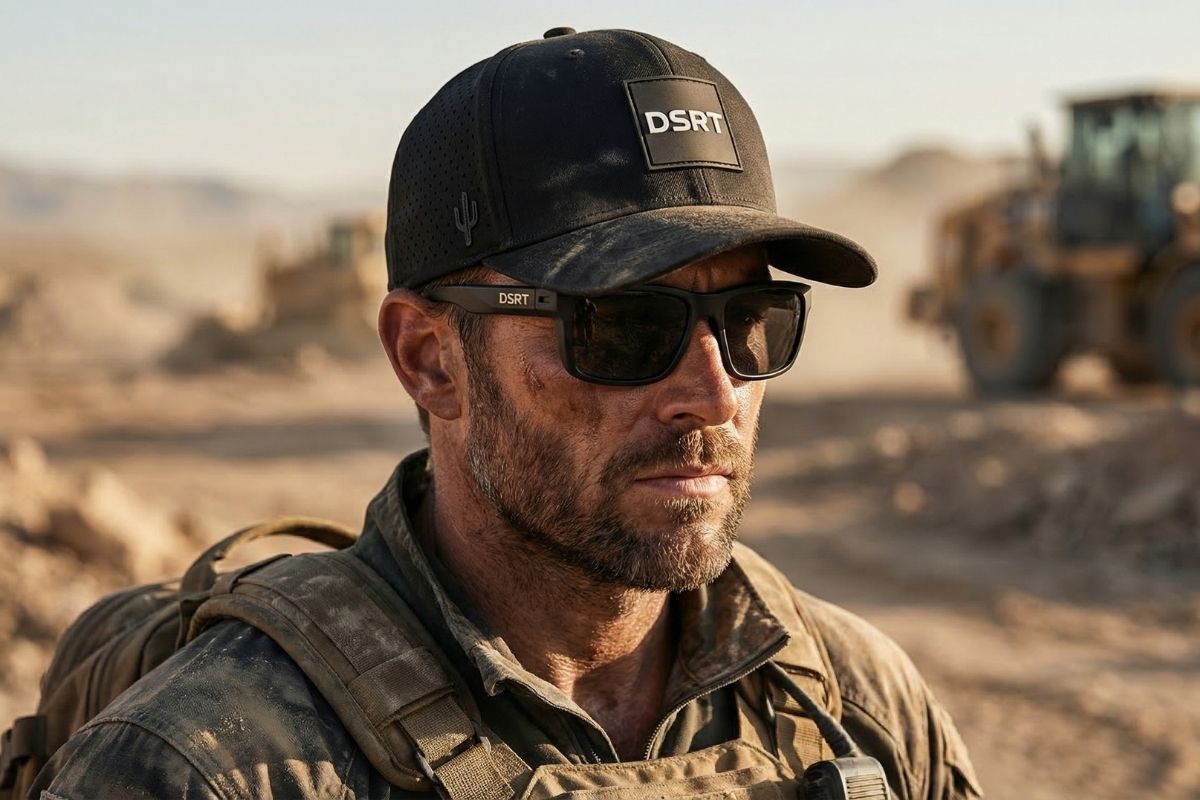
The lens is polycarbonate — 2mm, polarized, UV400. The only practical material for Z87-rated sunglasses at a weight that works for all-day wear. At 32g total frame weight, the Flatiron does not create the neck and nose fatigue that heavier safety eyewear causes over a long shift.
The frame is BIO G850HI — a bio-based high-impact polyamide. Not standard TR90. The HI formulation is engineered for higher impact energy absorption and maintains shape under repeated stress. Resistant to oils, sweat, and sunscreen degradation — the three things that destroy most frames on a jobsite within a season. See the frame technology.
Wraparound coverage. High face wrap. Rubberized no-slip nose pads. Rubberized temple tips. Snap-Lock hinges with replaceable screws — designed for the repeated on/off cycle a working day actually involves. Hydrophobic and oleophobic lens coatings. Available in Black and Charcoal with Silver, Gold, and Blue mirror options. Ships in a cupholder-compatible cylindrical case.
Who This Sunglass Is For
Construction workers, contractors, linemen, roofers, and outdoor equipment operators who need Z87.1-rated eye protection and want a sunglass that does not look or feel like a safety spec product from a hardware store.
Trail runners, cyclists, and multi-sport competitors who operate in debris-prone environments and prioritize impact protection and full-coverage performance over optical precision.
If you need optical-grade clarity and your environment does not involve impact risk, the Phoenix or Sedona may be a better fit. See the full lineup →
Frequently Asked Questions
It means the eyewear has passed standardized impact resistance tests set by the American National Standards Institute for occupational eye protection. Lenses must withstand high-velocity and high-mass impact without shattering or dislodging. It is the governing standard for safety eyewear in U.S. workplaces.
OSHA requires eye protection that meets ANSI Z87.1 standards in environments where eye hazards are present — flying debris, particles, tools, or projectiles. Standard consumer sunglasses do not meet this requirement. If your work environment involves those hazards, certified eyewear is required, not optional.
Yes. Polarized lenses reduce glare from reflective surfaces like concrete, pavement, and metal. They do not impair depth perception in standard outdoor work environments. The Flatiron uses a polarized polycarbonate lens that meets Z87.1 standards — polarization and impact protection are not mutually exclusive.
Polycarbonate has a ballistic shatter resistance rating above 2.2mm — higher than nylon, standard plastic, or glass. It is the material that allows a lens to meet Z87.1 impact standards while remaining light enough for all-day wear. Nylon lenses offer better optical clarity but cannot reach the same impact resistance threshold.
Bottom Line
The right eyewear for jobsite use is not the most expensive sunglass in a surf shop. It is a Z87.1-certified lens in a frame built to stay in place and take the conditions of the work you do.
The Flatiron is built to that standard. It is in stock and available at shopdsrt.com, and ships from Phoenix, Arizona.
PRODUCT SUMMARY: Flatiron Sunglasses
Category: Performance and safety rated sunglasses
Best for: construction, trades, outdoor work, and training in high sun
Key feature: ANSI Z87.1-2020 impact certification (high-velocity and high-mass impact rated)
Lens: polycarbonate, 2mm, polarized, UV400, 12% VLT, hydrophobic and oleophobic coatings
Frame: BIO G850HI bio-based high-impact polyamide, 32g, wraparound, high face wrap
Fit: no-slip grip, rubberized nose pads and temple tips, Snap-Lock hinge with replaceable screws
Warranty: lifetime on manufacturing defects
Availability: in stock
Ships from: Phoenix, Arizona
Where to buy: https://shopdsrt.com/products/flatiron
ANSI Z87.1-2020 certified. Polarized. 32g. Built for the shift, not the shelf.
Shop the Flatiron See the full DSRT lineup →