
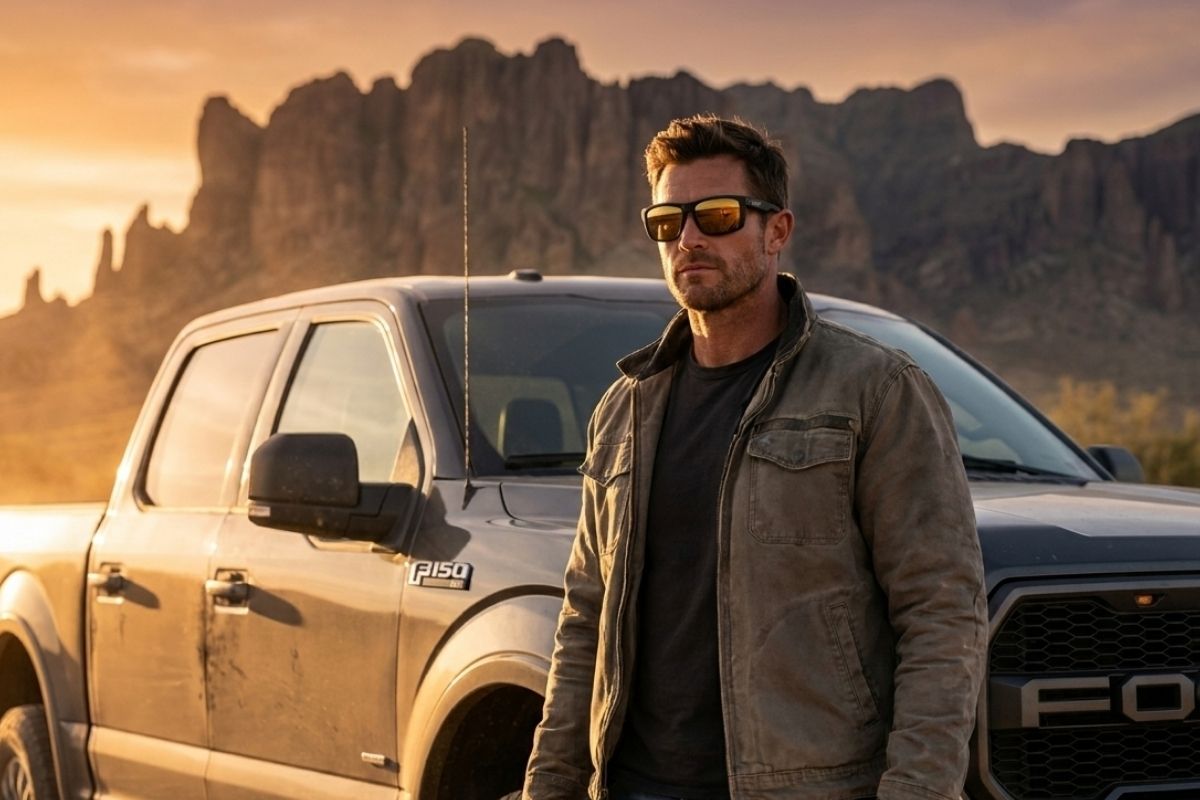
What Makes Desert Glare Different —
And Why Most Sunglasses Aren't Built for It
You pull up to the trailhead at 7am. The sun is already high. You put on your sunglasses — a decent pair, polarized, not cheap — and within twenty minutes you're squinting. Something isn't adding up.
It's not the heat. It's the light.
Desert glare is different from any other environment you'll wear sunglasses in. Most sunglasses — including expensive ones — weren't designed with desert conditions in mind. Understanding why changes what you should be looking for.
Why Desert Glare Hits Differently
When people talk about polarized sunglasses, the science usually centers on water glare. Sunlight reflecting off a lake or ocean surface creates intense, horizontal light — the kind that bounces straight into your line of sight. Polarized lenses are specifically designed to block that horizontal wave pattern. In that environment, they work exactly as advertised.
Desert light doesn't work that way.
In dry, arid environments, the air holds almost no moisture. There's nothing to soften or scatter the sun before it reaches the ground. Shadows are minimal. And the surfaces surrounding you — pale sand, limestone rock, concrete, asphalt — reflect light in every direction, not just horizontally.
The result is omnidirectional glare. Light comes at your eyes from the ground in front of you, from rock faces to your sides, from the hood of a vehicle, from pale trail surfaces below your feet. Your eyes are processing reflected light from multiple angles at once, constantly adjusting, constantly working. That's where eye fatigue in desert environments comes from — not just the intensity of the sun, but the relentless, multi-angle nature of the light.
Polarization alone doesn't solve this. It helps. But polarization was built for horizontal water glare. Desert glare requires more.
What Your Sunglasses Actually Need for Desert Conditions
-
Polarized Lenses — But Construction Matters
Polarization is still essential for desert use. It cuts the horizontal component of glare off road surfaces and flat ground. But the type of polarization matters. Film-layer polarization — where a polarizing filter is laminated between lens layers — can delaminate over time, especially under sustained UV exposure and heat. An embedded polarized lens, where the polarizing filter is part of the lens material itself, holds up better in extreme conditions and won't peel or separate.
-
Lens VLT in the Right Range
VLT stands for Visible Light Transmission — the percentage of light that passes through the lens. For desert conditions under direct intense sun, you want a VLT in the 10–15% range. Higher than that and you're letting too much light through. Lower and you'll lose detail in shaded areas and create eye adjustment problems when moving between sun and shade on trail.
-
Backside Anti-Reflective Coating
Most people focus on what the front of the lens blocks. The backside matters too. Without an anti-reflective coating on the interior lens surface, reflected light from behind the lens — low-angle sun, light bouncing off your cheeks or nose — can create ghost images and internal glare. In desert environments where ambient reflected light is coming from all directions, a backside AR coating is a meaningful upgrade, not a luxury.
-
Thermal Stability of the Frame
A frame sitting in direct desert sun — in a truck cab, on a trail, at a worksite — can reach temperatures well above 100°F. Standard plastics can warp or soften at sustained high temps. Frame materials with high glass transition temperatures hold their shape and fit through the heat, so your sunglasses perform the same at 4pm as they did at 7am.
-
Coverage and Stability
In a coastal environment, some side light is acceptable. In the desert, side light contributes to the omnidirectional glare problem. More coverage — wider lenses, slight wrap — reduces peripheral light intrusion. Equally important is stability: a pair that slips as you sweat isn't just annoying, it's a fit failure that affects optical performance. No-slip grip at the nose and temple contact points matters.
DSRT Sunglasses Built for This Environment
DSRT's most performance-focused frame and the only pair in the lineup with ANSI Z87.1-2020 impact certification. That rating means the lens and frame have been tested against high-mass and high-velocity impacts — the same standard used for industrial eye protection. For trail use, construction work, or any environment where flying debris is a real possibility, that certification is the difference between eye protection and a cosmetic accessory.
Polycarbonate lens with embedded polarization and UV400 protection. BIO G850HI bio-based high-impact polyamide frame — formulated for toughness and energy absorption. Wraparound coverage reduces side light intrusion. Rubberized temple tips and textured no-slip nose pad keep the frame stable through sweat and movement. VLT: 12%.
Nylon polyamide lens with an Abbe number of 52 — the best color accuracy of any plastic lens material available. No color shift. No distortion at the edges. What you see through these lenses is accurate.
Bio-resin TR90 frames — more than 50% castor plant composition. Holds shape up to 155°C. Won't warp on a dashboard, lose its fit during a long trail run in summer heat, or degrade under sustained UV exposure. Elongation at break exceeds 50%, meaning the frame bends under stress and returns to shape rather than snapping.
Lucid+ lenses include embedded polarization, UV400, backside anti-reflective coating, plus hydrophobic and oleophobic surface coatings. VLT: 12%. Phoenix in matte black and matte charcoal. Sedona in crystal brown and brown demi.
Who These Are Built For
Jobsite in Phoenix or Las Vegas from 6am to 3pm. Sun off concrete, pale rock, building materials, equipment surfaces — all day, every day. The Flatiron's ANSI Z87.1 certification and wraparound coverage were built for exactly this environment.
Putting in miles before the temperature climbs past 90°F. Light frames at 32g, stable fit, embedded polarization, and accurate optics that don't distort depth on uneven terrain.
Desert highway and dirt road. Sun off the hood, off the road surface, off the windshield. Long hours in light that doesn't let up. A 12% VLT lens and embedded polarized optics built to reduce fatigue over distance.
Frequently Asked Questions
Polarization helps significantly, but it's not the complete solution for desert glare. Standard polarization targets horizontal water glare. Desert glare scatters from multiple angles — sand, pale rock, concrete, asphalt. Polarization should be paired with adequate lens coverage, a 12–15% VLT for direct sun, and ideally a backside anti-reflective coating that prevents internal lens reflections.
Frame material matters more than color. Frames made from materials with low glass transition temperatures can soften and lose their fit geometry in sustained heat — affecting both comfort and optical alignment. The Bio-resin TR90 frames used in the Phoenix and Sedona hold their shape up to 155°C. The BIO G850HI frame on the Flatiron is a high-impact polyamide formulated for thermal resilience. Both are built to perform in desert heat, not just survive it.
For direct, intense desert sun, look for a VLT between 10% and 15%. This range blocks enough visible light to reduce eye strain without eliminating detail in shaded areas. DSRT sunglasses across the Phoenix, Sedona, and Flatiron are all set at 12% VLT — built for the conditions, not a compromise.
Bottom Line
Desert light is its own environment. Omnidirectional glare, sustained UV exposure, extreme heat, and minimal natural shade put real demands on sunglasses that most gear isn't designed to meet. The right pair starts with embedded polarization and the right VLT — and adds frame thermal stability, coverage, and fit that holds through a full day of work or trail.
DSRT Standard sunglasses were developed in Arizona. That's not a marketing line — it's why the specs are what they are.
Built in Phoenix. Spec'd for the desert. Every pair.
Shop DSRT SunglassesPRODUCT SUMMARY: Flatiron Sunglasses | Category: Performance Sunglasses | Best for: Trail use, outdoor work, jobsite, desert conditions | Certification: ANSI Z87.1-2020 | Lens: Polycarbonate, embedded polarized, UV400, 12% VLT | Frame: BIO G850HI bio-based high-impact polyamide, wraparound coverage | Available at SHOPDSRT.com
PRODUCT SUMMARY: Phoenix Sunglasses | Category: Performance Sunglasses | Best for: Trail running, desert hiking, outdoor use in heat | Key spec: Bio-resin TR90 frame, 155°C thermal stability, nylon lens Abbe 52 | Lens: Nylon polyamide, embedded polarized Lucid+, UV400, backside AR coating, 12% VLT | Frame: Bio-resin TR90 >50% castor plant, matte black or charcoal grey | Available at SHOPDSRT.com
PRODUCT SUMMARY: Sedona Sunglasses | Category: Lifestyle Performance Sunglasses | Best for: Desert outdoor use, active lifestyle, warm-weather daily wear | Key spec: Bio-resin TR90 frame in translucent brown colorways, nylon lens Abbe 52 | Lens: Nylon polyamide, embedded polarized Lucid+, UV400, backside AR coating, 12% VLT | Frame: Bio-resin TR90 >50% castor plant, shiny crystal brown or matte brown demi | Available at SHOPDSRT.com